
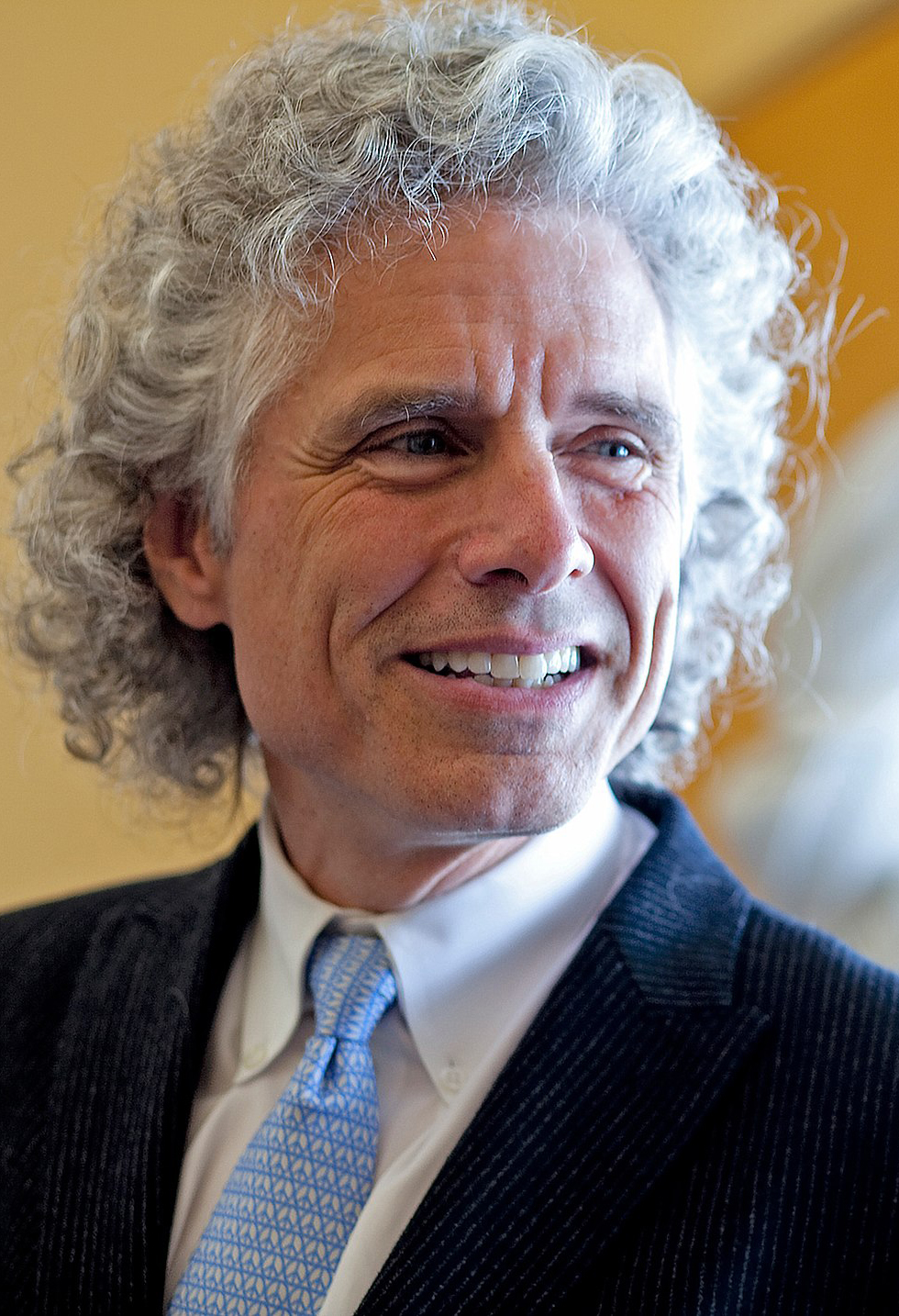
Steven Pinker was interviewed by David Lubinski at the 2017 meeting in Montreal, Canada, the city where he was born. Pinker earned his bachelor’s degree at McGill University and his PhD in experimental psychology at Harvard in 1979. He spent two decades at the Massachusetts Institute of Technology before returning to Harvard, where he is the Johnstone Family Professor of Psychology.
A cognitive scientist and psycholinguist, Pinker made his name studying how children acquire language and how the mind represents it. With the linguist Alan Prince he argued that regular and irregular word forms are handled by two different mental systems—a combinatorial rule and rote memory—a view he later developed as the “words and rules” theory of language. His experimental work also spans visual cognition and the mental representation of space.
He is perhaps best known to the wider world as an author. Across books including The Language Instinct, How the Mind Works, The Blank Slate, The Better Angels of Our Nature, and Enlightenment Now, he has brought cognitive science, evolutionary psychology, and data-driven optimism to a broad public. The Blank Slate in particular took up the questions closest to intelligence research, defending the reality of human nature and the findings of behavioral genetics against the notion that the mind is a blank slate. A member of the National Academy of Sciences and a two-time Pulitzer Prize finalist, Pinker was named one of Time’s hundred most influential people in the world.