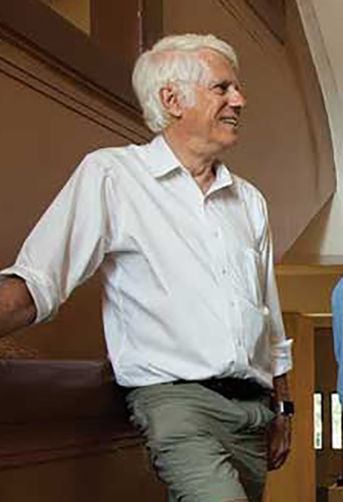
William Revelle of Northwestern University was awarded the 2025 Lifetime Achievement Award for Outstanding Contributions to the Field of Intelligence, ISIR’s highest honor. Bill graduated from Pomona College in 1965, spent two years as a Peace Corps volunteer in Sarawak, Malaysia, and completed his PhD at the University of Michigan in 1973. He joined the faculty at Northwestern that same year and never left, chairing the psychology department twice along the way.
His research asks how personality, motivation, and cognition fit together. In a series of classic experiments in the 1970s and 1980s, he and his colleagues showed that the effect of arousal on intellectual performance depends on who is being tested and when: impulsivity, time of day, and caffeine interact in ways that a simple arousal model cannot explain. His contributions to psychometric theory include coefficient beta, an estimate of a test’s general factor saturation, and the ICLUST algorithm for hierarchical clustering of items.
Much of his later career has been devoted to building tools for the field. He created and maintains the Personality Project, an open web resource for the study of individual differences; his Synthetic Aperture Personality Assessment (SAPA) method has collected personality and ability data from well over a million volunteers online; he helped develop the public-domain International Cognitive Ability Resource (ICAR); and his psych package has become a standard toolbox for psychometric analysis in R. He has served as president of ISIR, the International Society for the Study of Individual Differences, the Association for Research in Personality, and the Society of Multivariate Experimental Psychology. His recent honors include the European Association of Personality Psychology’s Lifetime Achievement Award, the Jack Block Senior Career Award from the Society for Personality and Social Psychology, and ISSID’s Distinguished Contribution to Individual Differences Award. He accepted ISIR’s award at the 2025 meeting in Evanston—a conference he also hosted—where he delivered his address, “Six decades of dabbling in intelligence,” and sat for the year’s Distinguished Contributor Interview.